
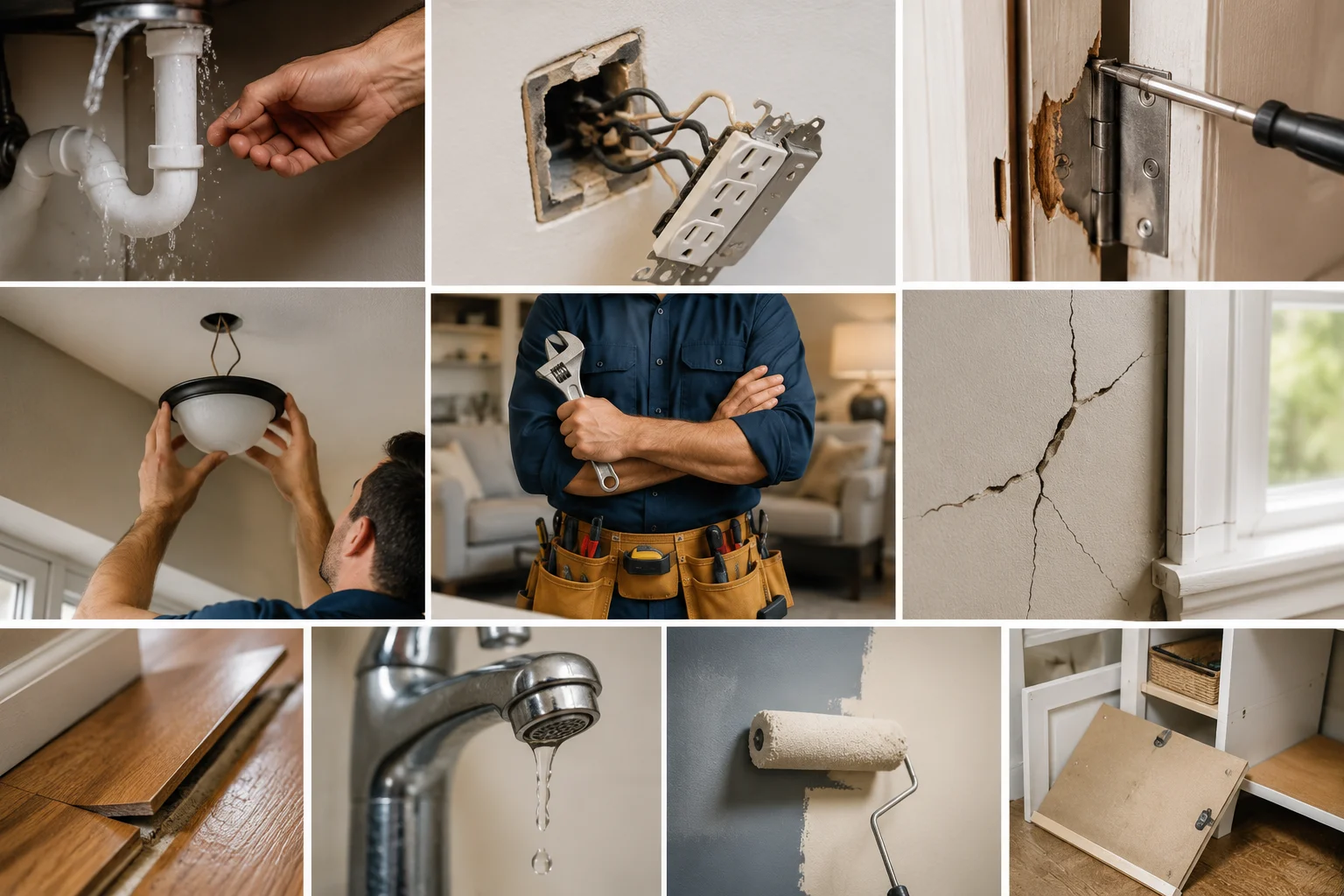
Every homeowner reaches a point where a weekend project outlasts their patience, their toolbox, or both. Knowing the signs you need a handyman can save you from a repair that costs twice as much the second time around. In Bradenton, Manatee County, and Sarasota County, Florida’s humidity, salt air, and hurricane season put extra wear on homes, which means small maintenance issues turn into expensive ones faster than they would inland.
This guide walks through ten clear signs it’s time to call a handyman instead of DIYing it, what a failed DIY attempt can actually cost you, and where Florida law draws the line between a handyman job and a licensed contractor’s job.
1. The Job Involves Electrical Work Beyond a Switch Plate or Fixture Swap
Replacing a light fixture, swapping an outlet cover, or installing a ceiling fan on existing wiring is usually a reasonable handyman task. But once a project involves running new circuits, working inside a breaker panel, or troubleshooting why an outlet keeps tripping, it has crossed into licensed-electrician territory.
This distinction matters in Florida specifically, because homeowners insurance can deny a claim tied to unlicensed electrical work, and improperly wired connections are a documented cause of house fires in older Gulf Coast neighborhoods. If you’re unsure which side of that line your project falls on, Shoreline’s electrician services in Bradenton cover everyday fixture, outlet, and switch work, and we’ll tell you upfront if a job needs to be escalated to a licensed electrical contractor.
2. A Plumbing Problem Keeps Coming Back
A single slow drain might respond to a plunger or a bottle of drain cleaner. A drain that clogs again two weeks later, or a faucet that keeps dripping after you’ve replaced the washer, usually points to a deeper issue: a failing valve, a vent problem, or corrosion inside older galvanized pipe, which is still common in homes built before the 1980s across Manatee and Sarasota County.
Repeated plumbing symptoms are one of the more common home repair warning signs homeowners dismiss until a small leak turns into water damage behind a wall or under a cabinet. Shoreline’s plumbing services for Bradenton homeowners handle leaks, fixture repairs, and recurring drain clogs, and can flag early when a job needs to be referred to a licensed plumbing contractor for repiping or water heater replacement.
3. The Project Requires a Permit or Touches Your Home’s Structure
Florida does not issue a statewide handyman license, but that doesn’t mean every repair is fair game for a DIY approach or an unlicensed worker. Under Florida law, minor repairs and maintenance generally totaling around $1,000 or less in combined labor and materials can be done without a contractor’s license. Anything involving structural changes, new electrical circuits, major plumbing work, or a job that legally requires a building permit does not qualify, regardless of how simple it looks.
Removing a load-bearing wall, extending a deck, or altering roofline framing are common examples homeowners underestimate. If you’re not sure whether your project needs a permit, that uncertainty is itself a sign to call a professional rather than guess.
4. You’d Need to Buy a Specialized Tool You’ll Never Use Again
Tile saws, stud finders rated for metal lath, pipe threading tools, and pneumatic nailers all have a place in a serious repair, but buying one for a single project rarely pencils out. Between the purchase price, the learning curve, and the risk of a mistake, a rented or borrowed tool often costs more in time than it saves in cash.
This is one of the clearest cases for when to hire a handyman instead of DIYing it: the job itself might be straightforward, but the equipment gap makes it inefficient to do yourself. A licensed pro already owns the right tools and knows how to use them correctly the first time. Shoreline’s handyman repair services in Bradenton cover this exact category of project, from trim carpentry to tile repair, without you needing to buy equipment that sits in a garage afterward.
5. You’ve Already Tried to Fix It — and It’s Worse Now
A second attempt at the same repair is a reasonable moment to stop and call someone. Stripped screws, a wobblier fixture than before, or a leak that’s now coming from a new spot are all signs the original problem was more involved than it looked, or that a repair attempt introduced a new one.
There’s no shame in this; it happens to experienced DIYers too. The more useful question is what it will cost to undo the extra damage versus calling in help now. If you’ve hit this point, request a free estimate and describe what’s already been tried. It helps a technician diagnose the problem faster and often keeps the repair cost lower than starting from scratch.
6. The Repair Puts You at Height or Otherwise at Risk
Gutter cleaning on a two-story home, roof-related repairs, and anything requiring a ladder on uneven ground carry real injury risk, and that risk doesn’t go away because a repair itself is simple. Working near a home’s electrical service, handling old insulation, or cutting into a wall without knowing what’s behind it carries similar risk.
A professional brings the right ladder, harness, or protective equipment for the job, along with the experience to recognize a hazard before it becomes an incident. If a project has you hesitating because of height, tools, or an unknown condition behind a wall, that hesitation is worth listening to.
7. Your Home Repair List Has More Than Three Items on It
A single loose cabinet hinge is a five-minute fix. A list that includes a loose hinge, a squeaky door, a wobbly handrail, a cracked bathroom tile, and a light fixture that’s been sitting in a box for months is a different problem entirely: it’s not about any one repair being hard, it’s about the list never getting shorter.
A handyman visit is built for exactly this scenario. One technician, one trip, and a punch list of common home repairs handled in a single afternoon is usually far more efficient than tackling them one weekend at a time over several months. It’s one of the most practical reasons Bradenton homeowners choose a handyman in Bradenton over chipping away at a growing list themselves.
8. It Involves a Safety System in Your Home
Smoke detectors, carbon monoxide alarms, GFCI outlets near water sources, and water heater pressure relief valves are not the place to improvise. These systems exist specifically to prevent injury, fire, or worse, and a repair that’s slightly off, a miswired GFCI, a smoke detector installed too close to a kitchen, can leave a home less safe than before the fix.
If a safety device is beeping intermittently, failing to trip during a test, or was installed by a previous owner in a way that looks questionable, it’s worth having a professional inspect and correct it rather than assuming it’s fine.
9. Hurricane Season Is Approaching (or a Storm Just Passed)
Florida’s hurricane season runs from June through November, and storm prep is one of the most time-sensitive reasons to call a handyman rather than work through it alone. Securing loose gutters, checking exterior caulking, clearing drains and downspouts, and confirming shutters or storm panels actually fit and operate correctly all take on urgency once a storm is in the forecast.
After a storm passes, a prompt check for water intrusion, screen enclosure damage, or wind-lifted roofing can catch a problem before it turns into mold or a much larger repair. For homeowners who travel frequently or aren’t sure they’ll be in town when a storm approaches, this kind of seasonal prep and post-storm check is often built into ongoing home watch services in Bradenton rather than handled as a last-minute scramble.
10. Your Home Sits Empty for Weeks at a Time
Manatee and Sarasota Counties have one of the highest concentrations of seasonal residents in the country. A slow leak, a struggling air conditioner, or a tripped breaker doesn’t announce itself when nobody is home to notice, and by the time a snowbird homeowner returns, a cheap handyman fix can have become a five-figure repair.
If your property sits vacant for extended stretches, pairing occasional handyman repairs with scheduled, documented home watch visits is one of the most cost-effective ways to protect a home you’re not living in year-round.
DIY vs. Handyman: What a Mistake Actually Costs You
The appeal of DIY is almost always the upfront savings, and for plenty of small jobs, that math holds up. But the comparison changes once a mistake is factored in. A stripped fitting that turns a $15 washer replacement into a $400 emergency plumbing call, or a poorly sealed exterior fixture that lets water into a wall over a Florida summer, can erase the original savings many times over.
Quick Cost Comparison
| Common Repair | Typical DIY Attempt Cost | Cost If a DIY Attempt Goes Wrong |
| Dripping faucet | $10–$25 in parts | $150–$400+ if the valve or supply line is damaged |
| Ceiling fan install | $40–$100 for the fixture | $300–$700+ if wiring is done incorrectly |
| Drywall patch | $15–$30 in materials | $250–$600+ if moisture behind the wall goes unaddressed |
| Exterior caulking/sealing | $10–$40 in caulk | $500–$2,000+ in water intrusion repair after a storm |
| Loose deck board/railing | $20–$60 in lumber | Liability exposure if a fall injury occurs |
These figures are general ranges, not quotes, since actual pricing depends on the scope of the job and what’s found once work begins. The pattern holds regardless of the exact numbers: the cost of doing a job once, correctly, is almost always lower than the combined cost of a DIY attempt plus the professional repair that follows it.
DIY vs. Handyman: How to Decide Before You Start?
Plenty of small home projects are genuinely fine to tackle yourself. The decision usually comes down to a few honest questions rather than a hard rule.
• Does the job involve wiring, gas lines, or water lines beyond a simple fixture swap?
• Does a mistake risk damaging a finished surface, a structural element, or a major system in your home?
• Do you already own the right tools, or would you need to buy something you’ll use once?
• Is there a real chance the job needs a permit or a licensed contractor once you’re into it?
• Do you have the time to do it once, correctly, without rushing?
If the honest answer to any of those is “I’m not sure,” that uncertainty is itself useful information. It’s usually cheaper in the long run to bring in a professional the first time than to pay twice, once for materials and time, and again for a professional to correct the attempt.
When Florida Law Requires More Than a Handyman?
It’s worth repeating because it trips up so many homeowners: Florida doesn’t issue a formal handyman license, but that doesn’t mean handyman work is unregulated. The Florida Construction Industry Licensing Board regulates contractors, and any job involving electrical wiring, plumbing systems, structural work, or a required permit needs a licensed contractor, not a handyman, regardless of the dollar amount involved.
Hiring outside those boundaries carries real consequences, from voided insurance coverage to legal penalties for the unlicensed party.
Insurance and Liability: The Risk Homeowners Often Overlook
Florida doesn’t legally require an unlicensed handyman to carry insurance for smaller jobs, but that doesn’t make it optional in practice. If an uninsured worker is hurt on your property, or damages something while working, that liability can land on the homeowner instead of the worker. It’s reasonable, and expected, to ask any handyman or contractor for proof of general liability insurance before work begins.
The same logic applies to DIY projects that go wrong. Water damage or fire damage traced back to unpermitted or incorrect DIY work can complicate a homeowners insurance claim at the exact moment you need that coverage to hold up.
The Bottom Line
Most of these ten signs come down to the same underlying question: does this job need specialized knowledge, tools, or licensing that you don’t have on hand, or is it genuinely a simple fix? Electrical and plumbing work beyond the basics, permit-level projects, repeated failed attempts, safety systems, storm prep, and a vacant property all point toward calling a professional rather than pushing through alone.
Shoreline Handyman & Home Watch Services has spent years helping homeowners throughout Bradenton, Manatee County, and Sarasota County tell the difference between a weekend project and a job that needs an experienced hand, and has built its approach around honest scope, fair pricing, and the kind of hands-on craftsmanship that comes from decades of combined trades and home-inspection experience.