
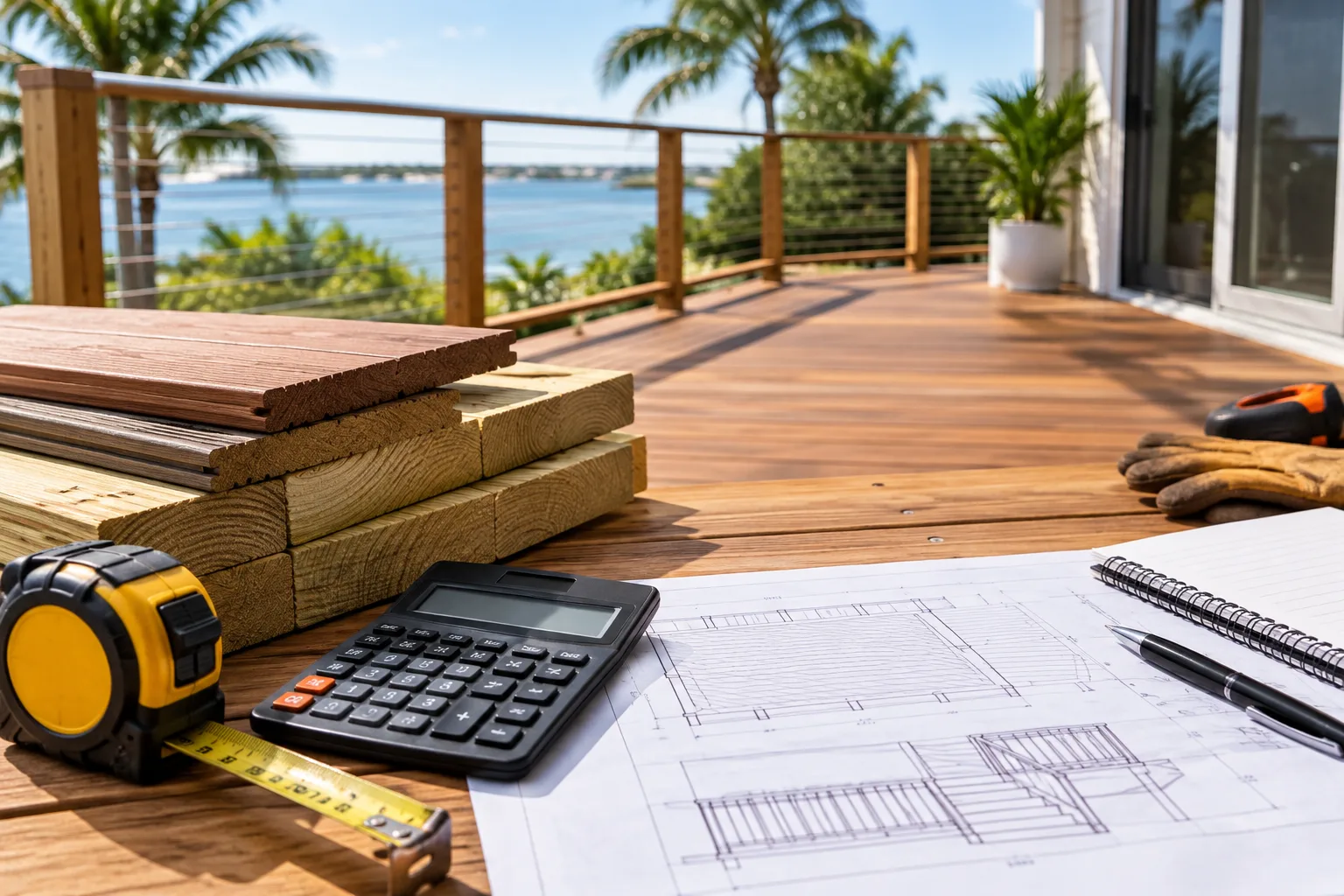
Planning a new deck usually starts with the same question: how much lumber, decking, and cash will this actually take? A deck material calculator takes your deck’s length, width, board size, and joist spacing and turns it into a materials list boards, joists, posts, fasteners, and concrete so you’re not guessing at the lumber yard or overpaying for a pile of leftover wood.
This guide walks through how a deck calculator works, how to run the numbers yourself by hand, and what a deck actually costs to build here in Bradenton, Manatee County, and Sarasota County where salt air, humidity, and Florida Building Code wind requirements change the math a bit from a national average.
What a Deck Material Calculator Actually Does
At its core, a deck calculator is a shortcut for math you could do on paper it just does it faster and with fewer mistakes. Plug in your deck’s dimensions, choose a decking material and board width, set your joist spacing, and the tool spits out:
- Number of deck boards needed, by length
- Framing materials joists, beams, and posts
- Fasteners (screws, hidden clips, or nails)
- A waste buffer, usually 10%, for cuts and mistakes
Most online tools labeled a decking calculator or deck board calculator only estimate the surface boards. A true deck material calculator goes further and includes the substructure the framing, footings, and hardware that actually hold the deck up. That distinction matters, because framing and labor typically make up the majority of total project cost, not the decking surface itself.
What You Need Before You Start Calculating
A calculator is only as accurate as what you feed it. Before you open any tool or start doing the math by hand gather these numbers:
- Length and width of the deck (measured to the outside face of the framing)
- Height off the ground, which affects post size and whether railings and stairs are required
- Board width and length you plan to use (5.5″ boards are standard for most composite and PVC decking)
- Joist spacing typically 16″ on-center, though composite manufacturers often require 12″ on-center for warranty compliance
- Decking orientation boards run straight (90°) use less material than a diagonal (45°) layout, which adds roughly 15% more waste
- Attached vs. freestanding design, since an attached deck ties into your house’s ledger board and ground-level or floating decks skip that step
If you’re unsure how your existing framing, siding, or electrical service will interact with a new ledger board attachment, it’s worth a second set of eyes before you finalize dimensions something our Bradenton handyman service team checks on every deck consultation.
Doing the Math Yourself: A Basic Lumber Calculator Approach
If you’d rather run the numbers manually instead of relying on an online lumber calculator, the framing math follows a fairly predictable pattern.
Step 1: Calculate Square Footage
Multiply length by width. A 14-foot by 20-foot deck, for example, comes out to 280 square feet a common size we’ll use as an example throughout this guide.
Step 2: Framing Calculator Basics Joists, Beams, and Posts
For a standard 16″ on-center joist layout, divide your deck’s width (in inches) by 16, then add one joist to account for the starting edge. A 20-foot-wide deck needs roughly 16 joists at that spacing. Beams typically run perpendicular to the joists and are sized based on the span and the load rating required by the Florida Building Code this is one area where guessing gets risky, since undersized beams are a common reason inspections fail.
Posts are spaced based on beam span, usually every 6 to 8 feet, and each post needs a concrete footing sized to local frost-depth and soil-bearing requirements (frost depth isn’t a factor in Florida, but soil-bearing capacity and hurricane uplift resistance still are).
Step 3: Deck Board Calculator Counting Boards and Waste
Divide your total square footage by the coverage area of a single board (width × length) to get a base board count, then add a 10% waste buffer for cuts, mistakes, and end trimming. Diagonal layouts and picture-frame borders should use closer to a 15–20% buffer.
Step 4: Fasteners
Budget roughly 350 hidden fastener clips per 100 square feet of decking if you’re using a clip system, or 5 screws per board if face-screwing directly into each joist.
Deck Stair Calculator: Don’t Forget the Stairs
Stairs are one of the most commonly under-budgeted parts of a deck project, and most basic online tools skip them entirely. A deck stair calculator accounts for:
- Total rise the vertical distance from the deck surface to the ground
- Riser height Florida Building Code generally caps this around 7¾ inches per step
- Tread depth usually a minimum of 10 inches
- Stringer count typically one stringer every 16 inches of stair width
For a standard deck 24–36 inches off the ground, expect one 3-4 step stair run to need 2–3 stringers, roughly 6-8 treads, and a matching set of risers if you’re using a closed-riser design. Stairs also affect railing requirements most jurisdictions, including Manatee and Sarasota counties, require guardrails on any deck surface more than 30 inches above grade.
Deck Cost Estimator: What Materials Actually Cost in 2026
Once you know the material quantities, the next question is always cost. Here’s how the major decking materials compare on price per square foot, materials only (labor and substructure are separate):
| Material | Cost per sq. ft. (materials only) | Notes |
| Pressure-treated pine | $10 – $25 | Most affordable; needs annual sealing in Florida’s humidity |
| Cedar / Redwood | $15 – $25 | Natural resistance to rot, but still needs periodic staining |
| Composite decking | $12 – $22 | Low maintenance, handles Gulf Coast humidity well |
| PVC decking | $15 – $25 | Fully synthetic, best moisture and salt-air resistance |
| Exotic hardwood (Ipe, etc.) | $20 – $35+ | Very durable, but heavy and harder to install |
Labor typically adds another $11–$35 per square foot on top of materials, depending on deck height, complexity, and whether stairs or built-in features are involved. All told, most fully installed decks land somewhere between $25 and $60 per square foot.
How Much Does a 14×20 Deck Cost?
Since it’s one of the most common sizes homeowners ask about, here’s a realistic 2026 breakdown for a 14×20 (280 square foot) attached deck:
| Material Choice | Estimated Installed Cost |
| Pressure-treated wood | $11,900 – $16,800 |
| Composite decking | $12,900 – $22,300 |
| PVC decking | $14,400 – $23,900 |
These ranges already account for substructure, railing, basic stairs, and labor not just the decking surface. A simple, ground-level pressure-treated deck with no railing can come in well under $10,000, while a raised composite deck with custom railing and lighting can push toward the top of these ranges or beyond. If you want a number specific to your yard, our team offers a free, on-site estimate rather than a generic online range reach out through our contact page and we’ll walk the space with you.
Florida-Specific Factors a National Deck Calculator Won’t Catch
Most deck calculators and cost guides you’ll find online are built around national averages, which misses a few things that matter a lot in Bradenton, Manatee County, and Sarasota County.
Humidity and Salt Air
Coastal humidity accelerates wood movement, warping, and fastener corrosion faster than it would inland. Stainless steel or coated fasteners are worth the upfront cost here, and pressure-treated lumber decks generally need sealing every 12–18 months instead of the 2–3 year interval that’s common in drier climates.
Wind Load and Hurricane Bracing
The Florida Building Code requires decks in our region to meet specific wind-uplift and lateral-load standards, which often means additional hurricane ties, deeper post embedment, or beefier ledger board attachment than a generic online calculator assumes. This isn’t a place to cut corners a deck built without proper hurricane bracing is one of the more common casualties during storm season. If you’re already thinking about storm readiness for the rest of the property, our hurricane home prep checklist covers what else to check before the season ramps up.
Permits in Manatee and Sarasota Counties
Nearly every attached deck, and any detached deck over 30 inches high or 120 square feet, requires a permit in Manatee County expect a fee in the neighborhood of $150–$200, plus plan review. Sarasota County has similar thresholds. Skipping the permit might save time upfront, but it can create real problems later at resale, since unpermitted structures often surface during a home inspection or appraisal.
Decking vs. a Tile or Paver Patio: Which Costs Less?
Some homeowners weighing a wood or composite deck are also considering a paver or tile patio instead, especially for ground-level spaces. A rough tile installation labor cost calculator comparison puts outdoor tile labor at $8–$15 per square foot on top of $5–$15 per square foot in material often landing close to composite decking on a per-square-foot basis, but with different maintenance demands (tile can crack with ground settling, while decking can warp or fade). If you’re torn between the two, it usually comes down to whether you want an elevated structure (deck) or a ground-level surface (patio), since that decision affects drainage, structural requirements, and long-term maintenance more than material choice alone.
DIY vs. Professional: When a Calculator Isn’t Enough
A deck material calculator is a great planning tool, but it has limits. It can tell you how many boards to buy it can’t tell you whether your soil can support the footings you’re planning, whether your existing ledger board attachment point is structurally sound, or whether your design meets current wind-load requirements.
Homeowners comfortable with basic carpentry often handle a simple, ground-level deck build themselves. Where we typically recommend bringing in a licensed pro:
- Any deck attached to the house at ledger height (structural connection to your home)
- Decks over 30 inches high, which trigger guardrail and stair code requirements
- Projects involving electrical work for outdoor outlets or lighting
- Anything requiring a permit and inspection sign-off
If you’re not sure which category your project falls into, our post on handyman vs. general contractor breaks down which type of pro handles what scope of work. And if the deck project is part of a longer list of things piling up around the house, it’s also worth reviewing the signs you need a handyman rather than tackling everything solo.
Planning to add deck lighting or a dedicated outdoor outlet while you’re at it? Wiring exposed to Florida’s weather isn’t a place to improvise our licensed Bradenton electricians can tie new circuits in safely and to code.
Maintenance: What Your Material Choice Means Long-Term
The material you choose changes what your maintenance routine looks like for the life of the deck:
- Pressure-treated wood needs a fresh seal or stain every 12–18 months in our climate, plus regular checks for soft spots or fastener corrosion.
- Cedar and redwood hold up naturally better than pine but still fade and need occasional staining to maintain color.
- Composite decking needs little more than periodic washing, though mold and mildew can build up in shaded, humid spots.
- PVC decking is the lowest-maintenance option overall and holds up best against salt air, though it carries the highest upfront material cost.
If you split time between Bradenton and somewhere up north for part of the year, a deck left unchecked for months is exactly the kind of thing that turns a small issue a loose board, a failing fastener, standing water after a storm into a bigger repair by the time you’re back. That’s a common gap our home watch service covers for seasonal residents, with routine visual checks on decks, screened areas, and other exterior features while you’re away. If you’re not familiar with how that service works, what is a home watch service lays out exactly what’s included.
Frequently Asked Questions
Does a deck material calculator include labor cost?
No. Most deck calculators, including material-only tools, estimate lumber, decking, and fasteners not installation labor, which typically runs $11–$35 per square foot depending on deck height and complexity.
What’s the difference between a deck calculator and a deck cost estimator?
A deck calculator focuses on material quantities how many boards, joists, and fasteners you need. A deck cost estimator applies pricing to those quantities (and often adds labor) to give you a total dollar figure.
How accurate are online deck calculators for Florida homes?
Reasonably accurate for material quantities, but most don’t account for Florida-specific wind load requirements, hurricane bracing, or the corrosion-resistant fasteners recommended for coastal humidity factors that can add cost beyond a generic national estimate.
Do I need a permit to build a deck in Bradenton or Sarasota?
In most cases, yes. Attached decks and detached decks over roughly 30 inches high or 120 square feet require a permit in Manatee County, and Sarasota County has similar thresholds. Check with the local building department before starting.
The Bottom Line
A deck material calculator is a genuinely useful starting point it turns your deck dimensions into a real materials list and gives you a ballpark on cost before you commit to a design. But between Florida Building Code wind requirements, coastal humidity, and local permitting rules in Manatee and Sarasota counties, the numbers a generic calculator produces are usually just a starting point rather than a final plan. The team at shoreline Handyman FL has walked through this exact math with homeowners across Bradenton and the surrounding area, and can turn a rough estimate into an accurate, code-compliant plan for your specific property.