
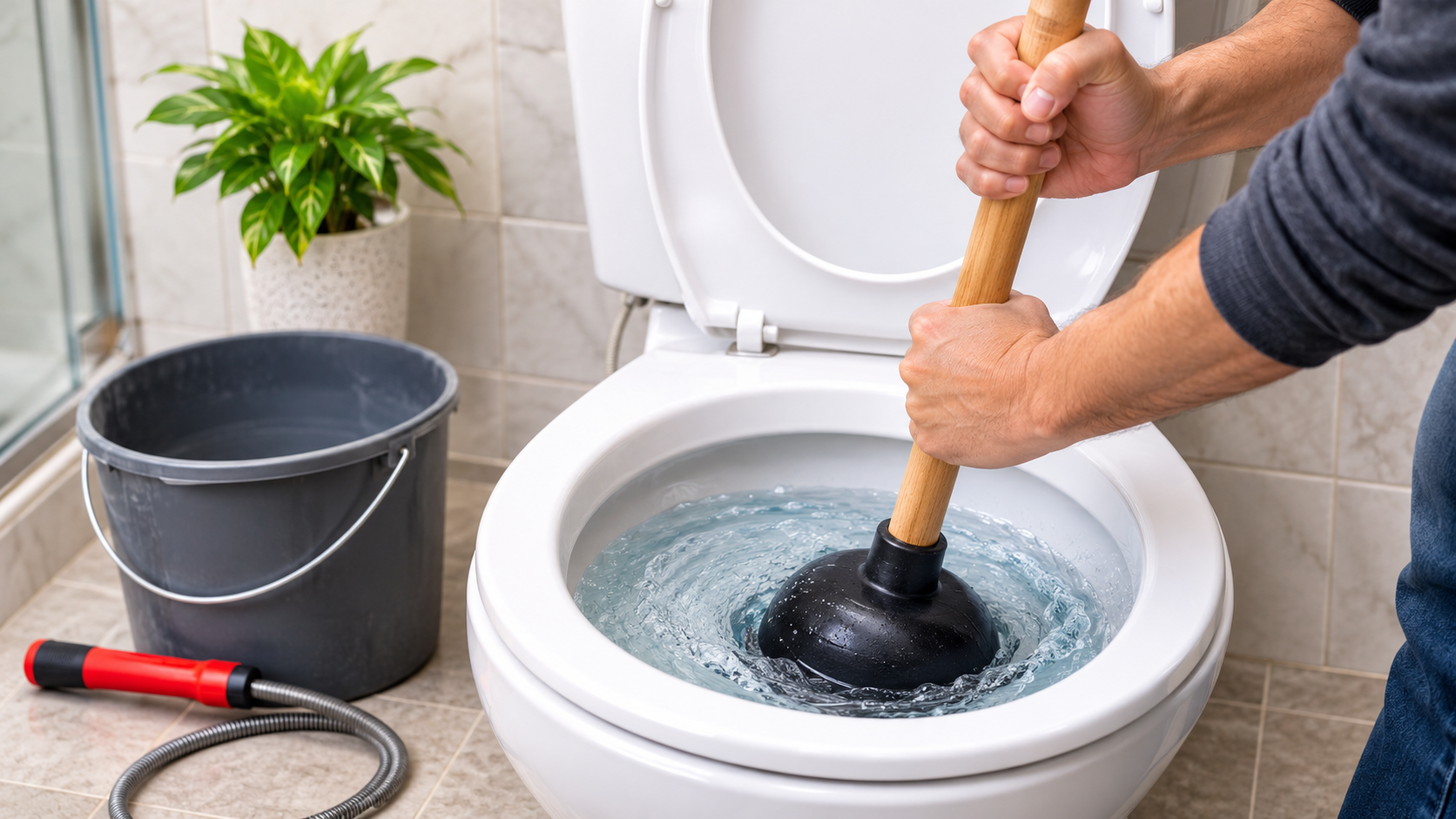
Here is how to unclog a toilet: stop flushing, then use a flange plunger with slow, firm push-pull strokes for 15-20 cycles. If that fails, squirt dish soap into the bowl and follow it with hot (not boiling) tap water. Still blocked? Use a closet auger. If none of these works, call a plumber.
Take a breath. Most clogs are soft blockages of paper or waste sitting in the curved trap built into the toilet, close to the bowl. With the right tool and a steady technique, a toilet clogged like that usually clears in minutes. You don’t need anything exotic to unclog a toilet fast. You need the right order.
This guide covers how to stop an overflow, three proven methods plus a last resort, why toilets keep clogging, how to pick the right tool, and when to call a plumber. It comes from our handyman and home watch team in Bradenton, FL, who deal with these clogs in homes across Manatee and Sarasota counties.
Before You Start: Stop the Overflow
Two minutes of prevention saves a wet floor and a ruined subfloor. Do these first, in this order:
1. Don’t flush again. A second flush on a clogged toilet is the most common way a bowl ends up on the floor.
2. If the water is rising, cut it off. Turn the supply valve on the wall behind the toilet clockwise until it stops. If the valve is stuck or water keeps coming, lift the tank lid and press the rubber flapper down onto its seat. It’s the same part that often causes a toilet that keeps running, so you’ll recognize it at the bottom of the tank.
3. Protect the floor and yourself. Lay towels around the base, put on rubber gloves and keep a bucket nearby.
4. Don’t pour chemical drain cleaner into a clogged toilet. It can splash back on you and turns plunging into a hazard. More on that below.
5. On a septic system, take extra care. Skip harsh chemicals entirely, because they can upset the bacteria your tank relies on.
Method 1: Use a Flange Plunger
A plunger clears most toilet clogs, but only if it’s the right type and it seals properly. Start here, because learning how to unclog a toilet with a plunger correctly solves the problem for most households.
How to Use a Plunger on a Toilet
What you need: a flange plunger (the kind with a soft rubber sleeve that folds out from the bottom of the cup), rubber gloves and towels.
Steps:
6. Check the water level. The cup must sit under water so you push water, not air. If the bowl is nearly empty, add water from a bucket. If it’s near the rim, bail some out first.
7. Soften the rubber (optional). Run the cup under hot tap water for a minute. Warm rubber seals better against porcelain.
8. Seat the flange. Insert the plunger at an angle so the sleeve goes into the drain opening and the trapped air escapes. Then press the cup flat for a full seal.
9. Push gently first. The cup is still holding some air, and a hard first push sends water over the rim.
10. Pump firmly, with the emphasis on the pull. Do 15-20 cycles without breaking the seal. The pull stroke is what loosens most clogs.
11. Test before you flush. Break the seal. If the water drains, pour in a bucket of water to confirm it flows. Then flush once while watching the bowl, with your hand ready on the supply valve.
How long to try: 2-3 rounds of 15-20 cycles.
When to stop: if the water rises toward the rim, the plunger won’t seal (wrong plunger type or a cracked bowl), or three rounds produce no movement at all. Move on to the dish soap method or the closet auger below.
Common mistakes: using a flat sink plunger, plunging an almost-empty bowl, jabbing hard on the first stroke and giving up after five pushes. Knowing how to use a plunger well matters more than how hard you push.
How to Unclog a Toilet Without a Plunger
Yes, dish soap and hot water can clear a soft clog made of too much toilet paper or waste. They won’t move a solid object such as a toy, phone or hairbrush, a wad of wipes, or a blockage further down the drain line.
What you need: liquid dish soap, a bucket and hot tap water.
Steps:
12. Bail the bowl down to about half full if the water is high.
13. Squirt in roughly half a cup of dish soap and wait 5-10 minutes so it slides down toward the clog.
14. Pour about a gallon of the hottest tap water into the bowl in a steady stream from waist height.
15. Wait 10-15 minutes, then test with a bucket of water before you flush.
Safety point: use hot tap water, never boiling water. A sudden jump in temperature can crack porcelain, and very hot water can soften the wax seal under the toilet.
This is the simplest way to unclog a toilet with dish soap, and it costs next to nothing. Baking soda and vinegar is harmless, but it fizzes more than it clears, so don’t count on it for a real blockage.
When to stop: two attempts with no change, or you know an object went down. Go straight to the closet auger.
Toilet Clogged and the Plunger Isn’t Working? Use a Closet Auger
When plunging fails, the clog is usually lodged inside the toilet’s built-in trap, and a closet auger is the tool made to reach it. Unlike a regular drain snake, it has a bent tube with a rubber or vinyl sleeve that protects the porcelain while the cable works (more on that in the tools section).
How to Use a Toilet Auger
What you need: a closet auger, gloves, towels and a bucket.
Steps:
16. Pull the cable fully back into the tube so only the tip shows.
17. Set the curved end in the bowl, sleeve resting against the porcelain, tip pointing up into the drain opening.
18. Crank the handle clockwise while gently pushing the cable down.
19. When you feel resistance, keep cranking. The tip will either break through the clog or hook it.
20. Pull the cable back while still cranking slowly, and remove anything it snagged.
21. Test with a bucket of water, then flush once.
How long to try: 2-3 passes.
When to stop: the cable is fully extended and the toilet is still blocked, or the clog clears and comes back quickly. Both point to a problem beyond the toilet, which is covered in the plumber checklist below.
Protect the bowl: don’t force or bang the tube. Scratches in the glaze pick up stains that never come out.
Last Resort: A Wet/Dry Vacuum
Use this only with a shop vacuum rated for wet pickup. A household vacuum isn’t built for water and is an electrical and motor risk. Bail the bowl out first, push the hose into the drain opening and wrap a towel around it to improve suction. Afterwards, empty and disinfect the vacuum. It works best on an object you can pull back out, and it’s messy, so many people reasonably skip it and call a professional.
Why Your Toilet Keeps Clogging
Why does my toilet keep clogging? The cause is usually what goes into it, how much water it uses to flush, or a problem further down the drain line.
· Low-flow toilets: older or early low-flow models flush with less force, so a heavy load of paper stalls in the trap. Flush in two stages when needed.
· Wipes, including “flushable” ones: they don’t break down the way toilet paper does. Put them in the trash.
· Too much paper at once: use less per flush, or flush partway through.
· Hard water scale: mineral buildup in the rim jets and trap weakens the flush over time. It’s common on parts of Florida’s Gulf Coast.
· A partial clog left behind: an object or buildup in the trap lets water through slowly and catches the next load.
· Vent or main-line problems: gurgling, slow drains elsewhere in the house, or a clog that returns within days. These are beyond DIY, and they’re among the clearest signs a repair needs a professional.
· Septic homes: a full or struggling septic system can show up as slow or backing-up toilets. Chemicals won’t fix it.
If the plunger or auger didn’t work, the tool you used may be the problem.
Which Method Fits Your Clog?
The best way to unclog a toilet is a flange plunger first, then a closet auger. Dish soap and hot water is a low-effort option for a mild, paper-only clog, and a wet/dry vacuum is a last resort for an object you can reach.
| Method | Best for | Effort and time | Tool cost | Stop when… |
| Flange plunger | Most everyday clogs (paper, waste) | Low, 5-10 min | Low (a basic household tool) | Water rises toward the rim, or no movement after 3 rounds |
| Dish soap + hot tap water | Soft, paper-only clogs, or no plunger on hand | Very low, 20-30 min wait | Near zero | No change after 2 tries, or an object went down |
| Closet auger | Clogs the plunger can’t move, or objects in the trap | Moderate, 10-20 min | Moderate | Cable fully out and still blocked, or the clog returns quickly |
| Wet/dry vacuum (wet-rated) | A retrievable object near the opening | Moderate and messy | Only if you already own one | No suction progress, or you’re unsure of the vacuum’s rating |
Choosing the Right Tool
Most failed DIY attempts come down to the wrong tool, not the wrong effort. Two minutes spent choosing correctly saves an hour of plunging.
Sink Plunger vs Toilet Plunger
A sink (cup) plunger has a flat rubber cup that seals against flat surfaces such as sinks and tubs. A toilet (flange) plunger adds a soft sleeve that fits into the curved drain opening of a toilet. The flat cup can’t seal in that opening, which is why it “doesn’t work” on a toilet.
Types of Plungers
· Cup: use on sinks, tubs and showers.
· Flange: use on toilets. This is the one to own.
· Accordion: delivers strong force on toilets, but it’s stiff, harder to seal and splashes more. Fine if you already have one.
When you buy, look for a flange that folds out fully, a handle long enough to keep your hands and face back from the bowl, and a grip you can hold firmly when it’s wet.
Toilet Auger vs Drain Snake
· Closet (toilet) auger: best for clogs in the toilet trap. A short cable runs through a bent tube with a protective sleeve. Its limit is reach: it only covers the toilet and the start of the drain.
· Standard drain snake: best for sinks, tubs and long branch lines. Its bare cable scratches porcelain and struggles to get around the toilet’s built-in trap, so it’s the wrong tool for a toilet.
If you’re choosing an auger, look for a rubber or vinyl sleeve on the bent end and a crank that turns smoothly.
Chemical Drain Cleaners vs Mechanical Methods
There’s no best liquid to unclog a toilet that safely replaces a plunger or auger. Chemical drain cleaners are a poor choice for a clogged toilet, for several reasons:
· Splash and burn risk: the cleaner sits in a full bowl, and anything that splashes onto skin or into eyes is dangerous. Plunging afterwards is the worst case.
· Fixture and pipe concerns: the heat or caustic action can harm older pipes and seals.
· Mixing hazard: never combine products. Different cleaners can react dangerously with each other.
· Septic systems: harsh chemicals can upset the bacteria a septic tank depends on.
The milder option is dish soap and hot water, as described in the no-plunger method above. Enzyme-based treatments suit slow organic buildup over weeks, not an emergency clog; they work slowly and have clear limits.
If the right tool still hasn’t cleared it, the clog is probably past the toilet.
When to Stop and Call a Plumber
Knowing when to call a plumber for a clogged toilet is simple: call when the clog keeps coming back, affects more than one fixture, or won’t move after both a plunger and a closet auger. Watch for these signs:
· The clog returns within days of clearing.
· Other drains gurgle, run slowly or back up, especially a nearby tub or shower.
· You smell sewage in the house or yard.
· Water rises after plunging instead of dropping.
· The plunger and the closet auger have both failed.
· Something valuable or hard went down and the auger can’t retrieve it.
· A septic home has slow drains throughout.
Any of these means you need a plumber for a clogged toilet, not another round of plunging. If the bowl is about to overflow, shut the supply valve behind the toilet first, then call. For hands-on help in Manatee and Sarasota counties, see our Bradenton plumbing service.
What It Costs and What Changes the Price
How much does it cost to unclog a toilet? It depends mostly on where the clog is and what it takes to reach it. A simple in-place clear sits at the low end; main-line work or a pulled toilet costs considerably more.
What moves the price:
· Severity and tool: a plunger or auger clear versus a camera inspection or line clearing.
· Location of the clog: in the toilet itself, or in the branch or main line.
· Timing: after-hours, weekend and emergency calls usually carry a premium.
· Pulled toilet vs in-place clear: removing and resetting the toilet adds labor and a new wax ring.
Before you hire a plumber to unclog a toilet, ask three questions: what’s the scope of the work, is there a trip or diagnostic fee, and what happens (and what does it cost) if the first method doesn’t work. For local context, our guide to what home repairs cost in Bradenton explains how jobs are priced in the area.
What to Expect When You Call in Bradenton and Sarasota
The process is straightforward: you call and describe the problem, you agree a visit time, the technician diagnoses the clog, and you get the price before any work starts.
Shoreline is led by Eric Poulin, a former home inspector with 10+ years as a firefighter and a hands-on tradesman; you can read more about Eric Poulin’s background. The team has cared for 100+ homes across Bradenton and Manatee and Sarasota counties.
If you own a seasonal home, a clogged or running toilet in an empty house can overflow or leak for weeks before anyone notices. Regular home watch visits catch problems like this early. When you’re ready, call +1 941-414-2835 to book a visit.
Toilet Clog FAQs
Can dish soap and hot water unclog a toilet?
Yes, when the clog is soft, such as paper or waste. Use hot tap water, never boiling. It won’t move wipes, solid objects or a blockage deeper in the line.
How do you use a plunger on a toilet?
Choose a flange plunger and make sure water covers the cup. Seal it over the drain opening, start with a gentle push, then work it firmly with a strong pull for 15-20 strokes.
What if my toilet won’t unclog with a plunger or a snake?
Try a closet auger if you haven’t, because a standard drain snake isn’t designed for toilets. If the auger also fails, the blockage is likely in the drain line, so close the supply valve and call a plumber.
Why does my toilet keep clogging?
The usual culprits are wipes, too much paper, a low-flow model, mineral scale or a partial clog left in the trap. If it keeps happening within days, or other drains gurgle, have the drain line inspected.
Conclusion: Unclogging Your Toilet Safely
Knowing how to unclog a toilet comes down to the right tool, used in the right order. Stop the overflow first, then try a flange plunger, then dish soap and hot water, then a closet auger. No chemicals in a clogged toilet, and if both the plunger and auger fail, call a plumber rather than forcing it.
When DIY isn’t enough, or a seasonal home needs someone checking on it while you’re away, Shoreline Handyman & Home Watch Services is the local team in Bradenton, Manatee and Sarasota counties you can turn to. Call +1 941-414-2835 or send us a message.