
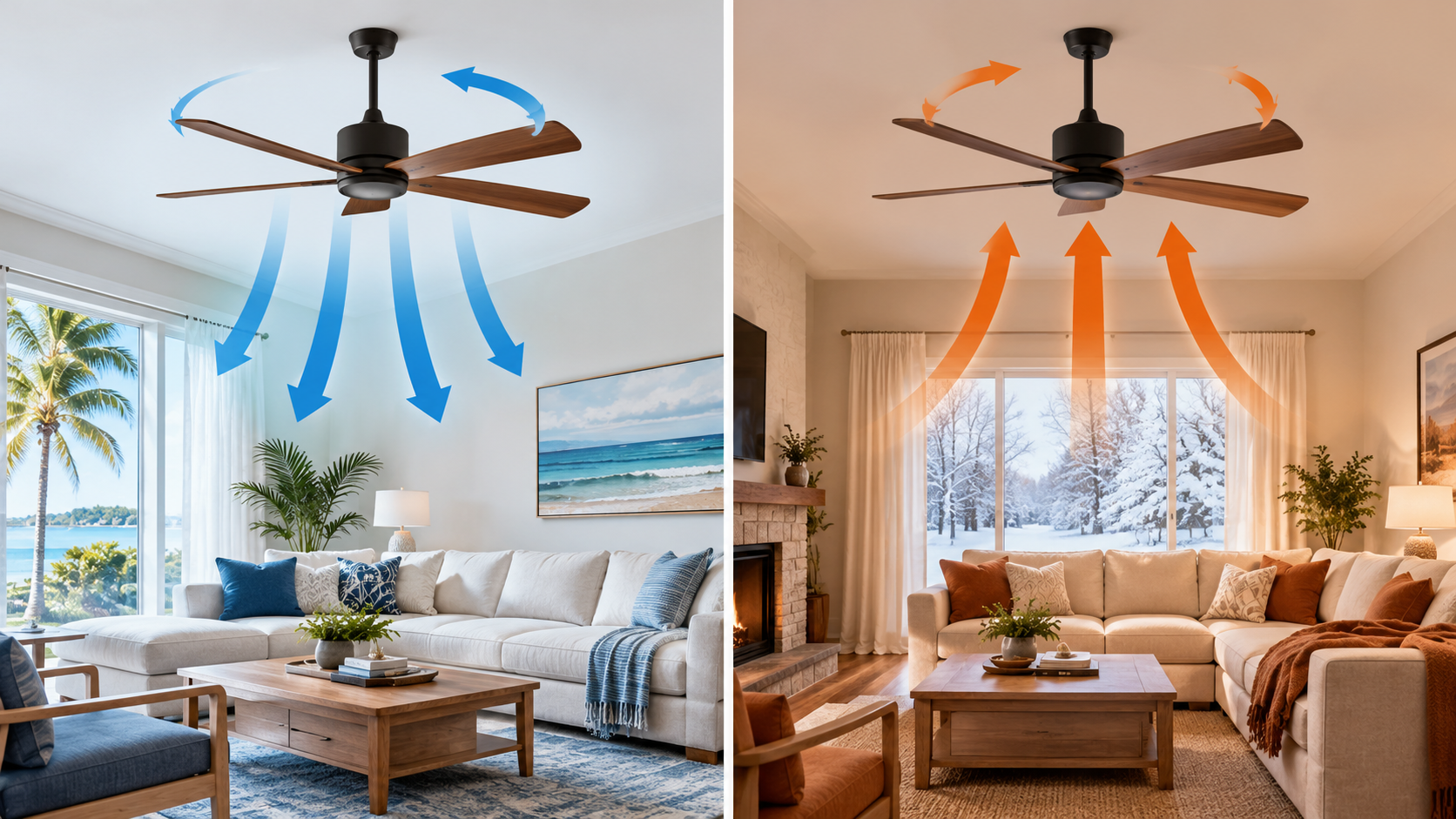
Most ceiling fans have a small switch that changes which way the blades spin, and most people never touch it. In a Florida home the fan runs most of the year, so getting your ceiling fan direction right matters more here than it does up north.
The short answer: run the fan counterclockwise (looking up from below) in summer for a cooling breeze. In winter, switch it to clockwise on low to gently move warm air down from the ceiling. This guide covers how to check and change the setting safely, how to run fans year-round in Florida, how to choose a fan and when to call a pro.
Which Way Should a Ceiling Fan Turn in Summer and Winter?
In summer, set your ceiling fan to spin counterclockwise when you look up at it. The blades push air straight down, creating a breeze that makes you feel cooler. In winter, switch it to clockwise on low speed. The fan then pulls air up and nudges warm air trapped at the ceiling back down the walls.
To cool down the room you’re sitting in, set the fan counterclockwise and run it on medium or high. Moving air speeds up the evaporation of sweat from your skin, which creates a wind-chill effect. You feel cooler, but the room’s actual temperature doesn’t drop. Counterclockwise is the ceiling fan direction for summer, and the U.S. Department of Energy recommends counterclockwise in summer, with the fan reversed to clockwise in winter.
Here’s the ceiling fan direction for winter and summer side by side:
| Season | Direction, viewed from below | Speed | What the air does | Florida note |
| Summer | Counterclockwise | Medium-high | Pushes air down for a direct breeze | This is your setting most of the year (roughly March-November) |
| Winter | Clockwise | Low | Pulls air up and moves warm air down the walls, with no direct draft | Useful on cool mornings or when the heat is running |
How to Tell Which Way Your Fan Is Spinning?
You can check your fan’s current setting in under a minute with any of these three tests:
· Look up from directly below. Set the fan on low, stand underneath and follow one blade. Picture the fan as a clock face on the ceiling. So which way is clockwise on a ceiling fan? If the blade travels the same way a clock’s hands move, the fan is turning clockwise (winter). If it travels the opposite way, like a clock running backward, it’s counterclockwise (summer).
· Feel for the breeze. Switch to high and stand under the fan. A strong, direct breeze means summer mode. If you feel little air on you and more movement around the edges of the room, it’s in winter mode.
· Check the blade tilt. In summer mode, the raised edge of each blade leads as it spins, scooping air downward.
The most common mistake is judging the direction from the side of the room or from a ladder. Always judge it from below, because that is how manufacturers and the DOE describe it.
If yours is spinning the wrong way, the fix takes about a minute.
What’s the Right Winter Setting for a Ceiling Fan?
If you’re wondering which way a ceiling fan should turn in the winter, the answer is clockwise, on the lowest speed. Warm air rises and pools at the ceiling. A slow clockwise fan pulls air up through the middle of the room and pushes that warm layer down along the walls, so the warmth spreads without the fan blowing on you.
Keep the speed low. On a higher speed the fan creates a draft that feels cold and cancels out the benefit.
Be realistic about the benefit here. Many Bradenton and Sarasota homes run the heat on only a handful of mornings a year. In those homes, the winter setting is a small comfort tweak, not a big money-saver. It helps most in rooms with high or vaulted ceilings, where more warm air collects overhead.
How to Change Your Fan’s Direction Safely (5 Steps)
Follow these steps to change your ceiling fan direction without straining the motor or risking your fingers:
1. Turn the fan off at the wall switch or the pull chain. If you’ll be touching the motor housing from a ladder, switching off the breaker is the safest choice.
2. Wait until the blades stop completely. Flipping the switch while the blades are still turning can strain the motor, and a moving blade can catch your hand.
3. Find the direction control.
· On most fans, the ceiling fan direction switch is a small slide switch on the side of the motor housing, just above the blades.
· On remote-controlled and DC-motor fans, look for a reverse button on the remote or wall control. Some models need you to press and hold it.
· Pull-chain fans still use the housing switch. The chain only controls speed.
4. Flip the switch or press reverse.
5. Restart the fan and confirm. Use the breeze test from the section above.
Shoreline owner Eric Poulin brings a former firefighter’s and home inspector’s eye to jobs like this, and the safety basics are the same every time:
· Use a stable step ladder, not a chair.
· Never reach into a moving fan.
· If the housing feels hot, smells burnt, or the switch is stiff or cracked, stop and don’t force it.
A fan that sparks, buzzes or dims your lights when it starts is showing one of the signs of an electrical problem in your home, and it needs a closer look before you use it again.
Does Ceiling Fan Direction Really Matter?
Yes, but not for the reason many people think. Direction changes how the air feels. A downdraft cools you through wind chill, and a slow updraft spreads warmth without a draft. The DOE supports both settings.
The biggest ceiling fan direction myth is that a fan cools a room. It doesn’t. It cools the people in the room, so a fan running in an empty room just uses electricity. That’s why it pays to switch a fan off every time you leave the room.
The real savings come from your thermostat, not the fan’s direction. DOE says a ceiling fan lets you raise the thermostat about 4°F with no loss of comfort, and a higher AC setting is where the lower bill comes from.
How to Run Your Ceiling Fan Year-Round in Florida?
Florida homes use fans differently from homes up north. They run for more months, deal with more humidity, sit empty for long stretches when seasonal owners leave, and face storm season. Here’s how to handle each situation:
· Most of the year: Run fans counterclockwise on medium-high, only in the rooms you’re using. Pair them with a slightly higher AC setting so the fan does some of the cooling work.
· Cool mornings (roughly December-February): If you run the heat at all, set fans clockwise on low. If you don’t run the heat, simply turn the fans off.
· Humidity: A fan doesn’t remove moisture. Only your AC or a dehumidifier does that. A fan makes humid air feel more comfortable, but don’t push the thermostat so high that the AC stops pulling moisture out of the air.
· Seasonal and vacant homes: Fans cool people, so leaving them running while you’re up north wastes power and wears out the motor. Switch them off before you leave and let your AC and dehumidification settings protect the house. A home watch visit while you’re away can confirm the fans are off and the AC is holding.
· Hurricane season: Turn indoor and lanai fans off before a storm and whenever the power is flickering. After a storm, check outdoor and lanai fans for water intrusion, loose blades or a wobble before you turn them back on. If water got into the fixture, leave it off and have it checked. It’s worth adding fans to your Florida hurricane prep checklist.
Everything above assumes your fan can reverse. Here’s how to check, and what to do if it can’t.
Does Your Fan Have a Reverse Switch? Reversible vs Non-Reversible Fans
Not every fan can change direction, and the controls vary. Here’s how to tell what you have and whether it’s worth upgrading.
How to Tell If Your Fan Can Reverse?
Most modern fans are reversible. They have either a switch on the motor housing or a reverse button on the remote or wall control. If you can’t find either, read the model number on the label on top of the motor housing and check it against the manual. A non-reversible fan only blows down, so it can’t use the winter setting.
In Florida, a reversible ceiling fan is nice to have, but it isn’t essential. You’ll run counterclockwise most of the year anyway, so a working non-reversible fan costs you very little. Don’t replace a good fan just for this.
Replacement makes sense when the fan is also noisy, wobbly or too small for the room. If it’s time to retire an old non-reversible fan, our handyman team can swap it out on your existing wiring.
Remote, Wall Control or Pull Chain?
· Pull chain: Simple and cheap, but you still need a ladder to reach the direction switch.
· Remote or wall control: Lets you change speed, and on many models direction, from the floor. The trade-off is batteries and receivers that can fail.
If you have a ceiling fan with remote control and the reverse button suddenly does nothing, a failed receiver in the canopy is one of the most common causes.
Is a Smart Ceiling Fan Worth It?
A smart ceiling fan adds app or voice control and schedules, and some models let you change direction from the app. The downsides are that it depends on Wi-Fi, costs more up front and adds another device to keep updated.
It suits seasonal owners best, because they can check and set fans from out of state. Most full-time residents are well served by a standard remote.
How to Choose a Ceiling Fan for a Florida Home?
If you’re replacing a fan, these are the details that decide whether it actually moves enough air and holds up in Florida humidity.
What to Look For
Use this checklist when you compare fans:
1. Blade span matched to room size. An undersized fan has to spin fast and loud and still won’t move enough air (see the size guide below).
2. Ceiling height. A hugger (flush-mount) fan suits low ceilings, and a downrod brings blades down to a comfortable height under high or vaulted ceilings. Always follow the manufacturer’s minimum floor clearance.
3. Blade pitch and airflow. A steeper blade angle generally moves more air at a lower, quieter speed, so compare the airflow figures on the box rather than the motor size.
4. Reversible motor. It’s worth having, but as covered above, it isn’t a deal-breaker in Florida.
5. Damp or wet rating. Use a damp-rated fan for covered lanais and bathrooms, and a wet-rated fan anywhere rain can reach it directly, such as open porches or unroofed pool cages. Indoor-only fans on a lanai corrode and fail early.
6. Light kit and controls. Decide whether you need light from the fan, and whether you want a pull chain, remote, wall control or smart control.
Ceiling Fan Size Guide by Room
Start by measuring the room: length × width gives you the square footage. Then use this ceiling fan size guide as a starting point, and check the manufacturer’s room-size rating on the box.
| Room | Typical size | Blade span |
| Small bedroom, office or laundry | Smallest rooms in the house | Smallest blade class |
| Average bedroom | Standard bedroom | Mid-size, 40s-inch class |
| Living room or large bedroom | Larger main rooms | Large blade class |
| Great room or open plan | Biggest open spaces | Largest blades, or two fans |
| Covered lanai | Varies by layout | Damp- or wet-rated, sized to the covered area, or two fans on a long lanai |
The bedroom row answers the most common question: an average bedroom usually needs a mid-size fan, not the smallest one on the shelf.
Best Picks by Situation
· Bedroom: Choose a quiet motor, a remote and a size matched to the room, because noise and a too-small fan are what keep people awake.
· Lanai or porch: Choose a damp- or wet-rated fan with corrosion-resistant finishes, because salt air and humidity break down indoor fans quickly.
· Low ceiling: Choose a hugger mount, because it keeps the blades at a safe height without a downrod.
· Seasonal owners: Choose a remote or smart fan, because you can set it without climbing a ladder or making an extra trip to the house.
If you’ve picked a fan, or the one you have wobbles, hums or won’t reverse, here’s when to call a pro.
When to Stop DIY and Call a Pro?
Flipping a direction switch is a homeowner job. These signs mean it’s time to stop and get someone qualified to look at the fan.
Signs Your Fan Needs Professional Repair
Book a ceiling fan repair if you notice any of these:
· A wobble that persists after you’ve tightened the blade screws and tried a balancing kit. A loose mount or a ceiling box that isn’t rated for a fan is a safety issue, not a cosmetic one.
· Grinding, clicking or humming from the motor.
· Lights that flicker or dim when the fan runs.
· A reverse switch or remote button that does nothing.
· No fan-rated ceiling box, or no wiring at the spot where you want a fan.
Heat, buzzing and flickering are exactly the electrical symptoms a firefighter learns to take seriously, so don’t wait them out. If you’re weighing a DIY fix, read up on the real risks of DIY electrical repairs first.
Handyman or Electrician: Who Should Install Your Fan?
The right ceiling fan installer depends on the wiring. A handyman can swap, mount and balance a fan on existing, safe wiring with a fan-rated box. New wiring, a new circuit or panel work goes to a licensed electrical contractor.
To be upfront: Shoreline Handyman & Home Watch is not a licensed electrician, and we refer larger electrical work to licensed contractors. A handyman ceiling fan installation is the right fit when the wiring and box are already in place.
What Affects Ceiling Fan Installation Cost?
How much does it cost to install a ceiling fan? It depends on the job. These are the factors that drive ceiling fan installation cost:
· Replacing an existing fan vs a first-time install
· Whether a new fan-rated box is needed
· Ceiling height, and the ladder or downrod involved
· Fan size and weight
· Adding a light kit
· Remote or smart setup
· Whether new wiring by a licensed electrician is required
Shoreline offers free estimates for clearly defined jobs, and a service-call fee may apply for troubleshooting. For broader context, see what handyman work typically costs in Bradenton.
Getting Help in Bradenton and Sarasota
Getting help is simple. Call or request an estimate, describe the fan and the problem, and we’ll set a time. Your fan is mounted securely, connected correctly and balanced. Shoreline serves Bradenton, Manatee County and Sarasota County, with 100+ homes cared for.
If your fan wobbles, hums or won’t reverse, book ceiling fan installation and repair in Bradenton or call 941-414-2835.
FAQs
Which way should a ceiling fan go to cool down a room?
Counterclockwise when viewed from below, on medium or high. The breeze cools the people in the room through wind chill. The room’s temperature itself stays the same.
How do I know if my ceiling fan is set for summer or winter?
Run it on high and stand directly underneath. If you feel a strong breeze, it’s on summer (counterclockwise). If you barely feel any air, it’s on winter (clockwise).
Which way should a ceiling fan turn in winter?
Clockwise, at the lowest speed. That setting brings warm air from the ceiling back down without a chilly draft.
How can I tell if my fan is going clockwise or counterclockwise?
Stand right under the fan and track a single blade. If it follows the path of a clock’s hands, it’s clockwise. If it moves the other way, it’s counterclockwise.
Conclusion
Getting the ceiling fan direction right is a one-minute job. Run the fan counterclockwise for summer, which in Florida means most of the year, and switch to clockwise on low for the occasional cool morning. Always cut the power and let the blades stop before you flip the switch. Fans cool people, not rooms, so turn them off when you leave.
If your fan won’t reverse, wobbles or hums, or you’re choosing a new one for a lanai or bedroom, Shoreline Handyman & Home Watch is the local team to turn to next.