
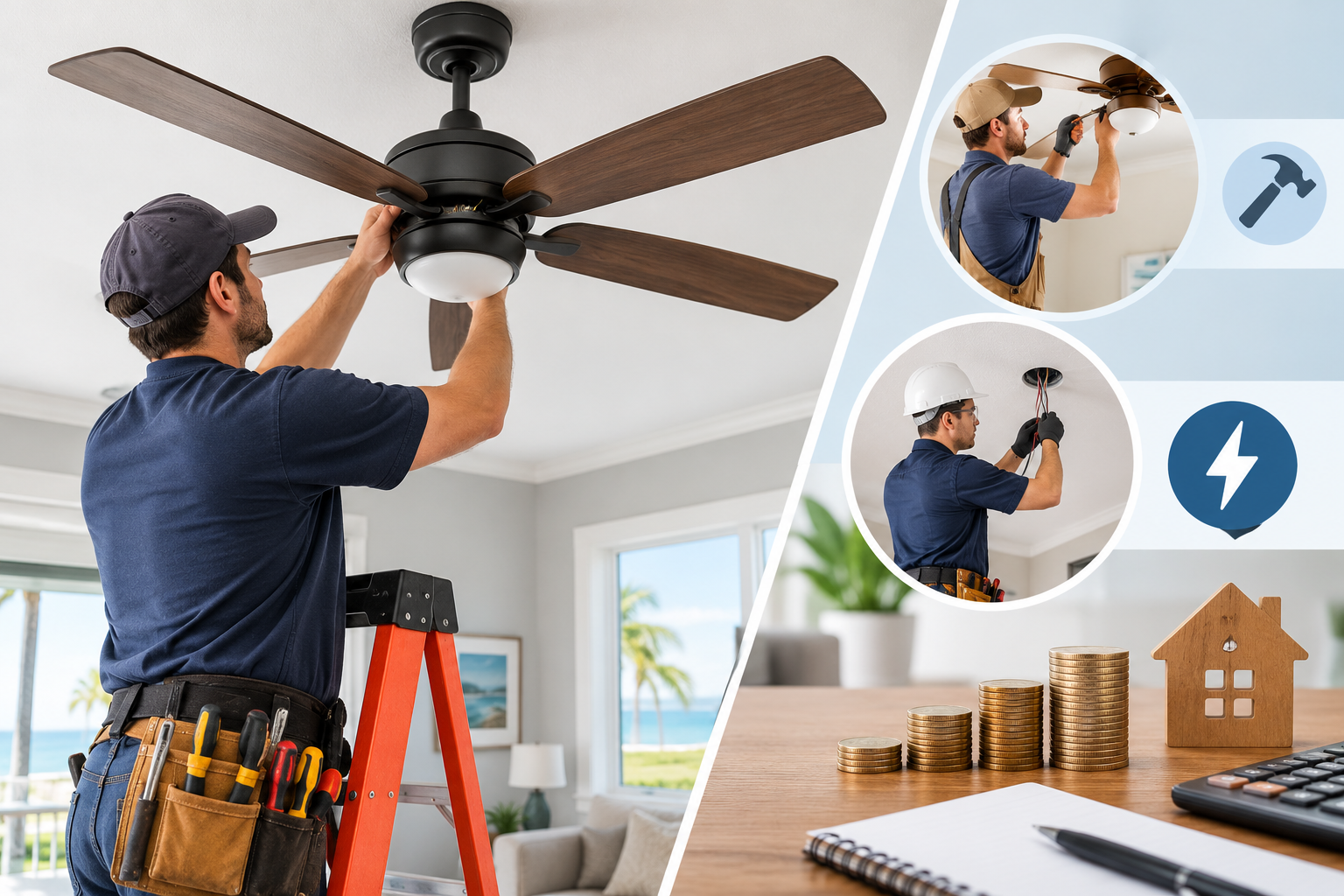
A Florida summer is long, and so is the gap between the three quotes you got for one wobbly old fan. Your ceiling fan installation cost depends on a few things you can check yourself before anyone climbs a ladder. Once you know them, the quotes start to make sense.
What does it cost to install a ceiling fan in Bradenton or Sarasota? The price depends mostly on whether wiring and a fan-rated box are already in place. Swapping a fan onto an existing fan-rated box is the low end. New wiring, a new switch or a ceiling brace raises the price, and that work needs a licensed electrician. Ceiling height and fan type move it further.
This guide covers prices by job type, what a visit includes, who should do the work in Florida, what changes the price, and how to read a quote.
Ceiling Fan Installation Cost by Job Type (2026 Prices)
Ceiling fan installation cost in Bradenton and Sarasota varies a lot by job. The table below lists six common fan jobs in 2026. It covers labor only. Some installers supply the fan and some don’t, so ask before you compare.
We quote every fan job after seeing the box and wiring, because those two things decide the price. The $ signs show how the jobs compare, and the real number comes with the quote.
| Scenario | What’s involved | Who does it | Relative cost |
| Replace a fan on an existing fan-rated box | Remove the old fan, mount, wire to the existing connections, balance, test | Ask for the installer’s license (see the Florida section below) | $ |
| New fan where a light fixture already is | Same steps, plus confirming or replacing a light box that may not be fan-rated | Ask for the installer’s license | –$ |
| Fan box or brace upgrade | Replace a light box with a fan-rated box, or add a brace between the joists | Ask for the installer’s license | Add-on: + $ |
| New wiring or a new switch run (no fixture there now) | Run a new cable, add a switch, possibly a new circuit | Licensed electrician | $$$ |
| Vaulted or high ceiling | Taller ladder or scaffold, extension downrod, more labor | Ask for the installer’s license | Add-on: + –$ |
| Old fixture haul-away | Removing and disposing of the old fan or light | Any installer | Often small or included |
Why the rows differ?
Three things separate the cheap rows from the expensive ones.
· Is wiring already there? If a fan or light already hangs in that spot, the cost to replace a ceiling fan is mostly labor for the swap. If the ceiling is bare, someone has to run cable and add a switch, and that is a different job.
· Is the box rated for a fan? Plain light boxes are common in older homes. Swapping a light for a fan can turn into a box or brace upgrade once the installer looks inside.
· How high is the ceiling? A standard 8-foot room is quick work. A vaulted great room adds equipment, a longer downrod and extra time, which pushes the ceiling fan replacement cost up even when the wiring is fine.
If you’ve been quoted a handyman cost to install a ceiling fan that seems far below what others charge, check what’s left out. The usual gaps are the box check, haul-away and any permit.
Here’s what that work involves.
What a Ceiling Fan Installation Actually Includes?
A typical visit is a safe shutdown, removal, a box check, mounting, wiring, balancing and testing. If you’ve watched a video on how to install a ceiling fan, the steps look simple. The price depends on what’s behind the ceiling.
This isn’t a DIY tutorial. It’s a plain list of what you’re paying a pro to do:
1. Turn off the circuit at the breaker and test that it’s dead.
2. Remove the old fan or light.
3. Check that the ceiling box is fan-rated and solidly fixed.
4. Mount the bracket.
5. Hang the fan and connect the wiring.
6. Attach the blades and balance them.
7. Test the speeds, the light and the switch or remote.
A few terms come up in every quote. A fan-rated box is a metal or plastic ceiling box listed and marked to carry a moving fan. The mounting bracket is the plate that screws to the box and holds the fan. The downrod is the metal pipe that drops the fan below the ceiling.
If you’re searching how to replace a ceiling fan, know that a replacement reuses the existing box and wiring. A new install may need a new box, cable and switch, which is why the price jumps in the table.
The step that changes the price most is step 3.
Why Wiring and the Ceiling Box Drive the Price?
Existing wiring versus none is the biggest price swing on any fan job. With wiring and a switch already in place, the job is a swap. With nothing there, it’s new electrical work.
If you want to know how to install a ceiling fan without existing wiring, the short answer is that a cable has to be run from a power source, usually with a new wall switch, through the attic or ceiling. That is licensed electrical work, and it’s the top-cost row in the table above.
Ceiling fan wiring also matters when wiring exists. A fan-only setup on one switch is simple. A fan-and-light setup with separate control may need an extra conductor between the switch and the ceiling, or a remote kit if that conductor isn’t there. Wire colors and diagrams are a separate how-to.
The box is the safety point. Under the NEC, a box used to support a ceiling fan must be listed and marked as suitable for fan support, a fan over 35 lb needs a box marked with its maximum weight, and fans over 70 lb must be supported independently of the box. A spinning, slightly wobbling fan loads the box far more than a still light ever does.
Flickering lights, a warm switch plate or wiring from decades ago are all warning signs your wiring needs a look before any fan goes up.
Is It Hard to Install a Ceiling Fan, and How Long Does It Take?
Is it hard to install a ceiling fan? A like-for-like swap on a correct, fan-rated box is manageable for some handy homeowners. The hard parts are confirming the box is rated, getting the wiring right, and holding a heavy fan overhead on a ladder while you connect it. Most problems start with one of those three.
How long does it take to replace a ceiling fan? A straight swap is usually a single, short visit. A box upgrade, a high ceiling or new wiring adds time, and new wiring can take noticeably longer because cable has to be routed through the attic or ceiling.
Which of those jobs needs an electrician? That’s next.
Handyman vs Electrician: Who Should Install Your Fan in Florida?
Do you need an electrician to install a ceiling fan? For any job that adds wiring, a switch, a circuit or a new box, yes. For a straight swap, the answer depends on who is licensed for the electrical connection, so ask before work starts.
| Like-for-like swap on a fan-rated box | New wiring, switch, circuit or box | |
| Scope | Remove, mount, reconnect, balance | Run cable, add a switch or circuit, install a box or brace |
| Relative cost | $ | $$$ |
| Licensing in Florida | Ask for the license number (see below) | Licensed electrical contractor |
| Permit | Ask your installer; the local building department decides | More likely; ask your installer and the local building department |
| Right call when | The box is fan-rated, the wiring is sound and the new fan is similar in weight | No fixture exists, the box isn’t fan-rated, the wiring is old or aluminum, there are panel concerns, or a permit is needed |
Florida licenses electrical work separately from general handyman work. Before anyone touches your wiring, ask for their license number and look it up on the Florida DBPR’s license search. That one check answers the licensing question before you pay anything.
Many people start by looking for a handyman to install a ceiling fan because the job feels small. That can make sense for the non-electrical parts of a fan job, such as patching and painting around an old fixture. The wiring connection is where you need the right license.
Some jobs should go straight to an electrician to install a ceiling fan: old or aluminum wiring, breakers that keep tripping, scorch marks or a warm box, no existing fixture, or anything that needs a new circuit. For those, call a licensed Bradenton electrician rather than a general installer.
What Changes the Price: Height, Fan Type and Other Factors?
Once you know whether the job is a swap or new wiring, these five things move your ceiling fan installation cost up or down. Most are visible from the floor, so you can spot them before the installer arrives.
Ceiling height and mounting style
The flush mount vs downrod ceiling fan choice comes down to ceiling height. Low ceilings need a flush or “hugger” fan that sits tight to the ceiling. Standard and tall ceilings use a downrod, and vaulted ceilings need an angled mount and a longer rod, plus more ladder or scaffold time.
Not every fan can be flush mounted. Only fans designed for it work that way, because blade clearance and airflow depend on the fan’s own low-profile design.
Fan type, size and weight
The main types of ceiling fans you’ll see quoted are standard, low-profile, with or without a light kit, smart or remote-controlled, and large-diameter fans for great rooms. Heavier and larger fans take more labor to hang and balance. They can also trigger the box or brace upgrade covered in the wiring section.
Lanais and porches are their own case. A fan used outdoors or in a humid space should be listed for damp locations, or for wet locations where rain can reach it directly. Check the box and listing label for a damp or wet rating before you buy.
The ceiling box and any brace
Whether the existing box is fan-rated is the hidden variable in most quotes. If it isn’t, a brace between the joists fixes it, and easy attic access above the room keeps that work faster.
Old-fixture removal, permits and trip fees
Haul-away of the old fan or light is often small or included, but confirm it. Whether a permit is needed is decided by the City of Bradenton, Manatee County or Sarasota County building departments, so ask your installer which applies to your address.
Most companies also have a minimum service or trip fee, which is why bundling small jobs into one visit lowers the cost per job. For more on how local jobs are priced, see our guide to how handyman pricing works in Bradenton.
Deciding before you book
For how to choose a ceiling fan, settle only what affects the quote: fan size for the room, indoor or damp-rated, light or no light, remote or wall control, and whether you supply the fan or the installer does. Picking the fan itself is a separate shopping decision.
DIY or Hire a Pro? An Honest Look
Can you replace a ceiling fan yourself? Sometimes. Here’s the trade-off.
DIY
· Saves the labor cost.
· Fine for some people on a true like-for-like swap.
DIY risks
· A light box that isn’t fan-rated.
· Loose or reversed connections.
· Wobble from poor balancing.
· Ladder work with a heavy fan.
· Working on a circuit you thought was off.
Hiring a pro
· Costs labor.
· Includes the box check, the right hardware and, with many installers, a labor warranty.
Before you decide, read up on the real risks of DIY electrical work. Once you know the job, here’s how to judge a quote.
How to Read a Ceiling Fan Quote in Manatee and Sarasota?
Two quotes for the “same” fan in Manatee and Sarasota can differ widely. The gap usually sits in what each one includes, not in the installer’s hourly rate.
What a good quote lists
8. Fan supplied, or labor only.
9. Labor as a flat total or hourly.
10. Box or brace work, stated as included, extra or not needed.
11. Old-fixture haul-away.
12. Permit: needed or not, and who pulls it.
13. A warranty on labor, with its length.
14. The trip or minimum fee.
Red flags
· No itemization.
· Cash only with no written quote.
· No mention of the ceiling box.
· No license number when you ask.
· A very low price that grows with “extras” on the day.
Questions to ask before you book
· “Will you check that the box is fan-rated?”
· “Who is licensed for the wiring, and what’s the license number?”
· “Is the price flat or hourly?”
· “Do you balance the fan and test every speed?”
· “What’s your warranty on labor?”
Whether you’re booking handyman ceiling fan installation or an electrician, these questions apply the same way. Use this list with any installer you call, including us.
Getting Your Ceiling Fan Installed by Shoreline
Shoreline Handyman & Home Watch Services is a Bradenton handyman, electrician, plumber and home watch service covering Manatee and Sarasota Counties.
Fan jobs go down two routes. Wiring work, new switches, new boxes and anything flagged in the electrician section go through our electrician service. For the finishing work around a fan job, such as patching and painting the ceiling where an old fixture came down, our Bradenton handyman team can handle it on the same visit. A straight swap starts the same way as everything else: send the photo, and we’ll tell you which route fits.
Here’s how it works:
15. Send a photo of the fixture and ceiling box, or call us.
16. We look at the box, the wiring and the ceiling height.
17. You get a written quote before any work starts.
We offer free estimates for most straightforward projects.
Ceiling Fan Installation FAQs
What does it cost to install a ceiling fan in Bradenton?
It depends on the job. A swap onto an existing fan-rated box is the low end of the table above, and running new wiring to a bare ceiling is the high end, with box upgrades and high ceilings in between.
How much do electricians charge for ceiling fan installation?
It depends mostly on whether new wiring or a new box is needed. Wiring a fan into a ceiling with no fixture is the most expensive fan job, because it means running cable and often adding a switch.
Is it hard to replace a ceiling fan?
A swap on a box that’s already rated for a fan is within reach for some confident homeowners. The tricky parts are checking the box, making the right wire connections and supporting the fan’s weight overhead.
Can any ceiling fan be flush mounted?
No. Only low-profile (“hugger”) models are designed to mount tight to the ceiling, and they belong in rooms with low ceilings.
Can a handyman install a ceiling fan in Florida?
Florida licenses electrical work separately from general handyman work, so the wiring connection is the part to ask about. Ask for the license number and check it on DBPR.
Are ceiling fans worth installing in Florida?
Usually, yes. The U.S. Department of Energy says a ceiling fan lets you raise the thermostat setting about 4°F with no loss of comfort. Fans cool people, not rooms, so turn them off in empty rooms, and set the blade direction for summer to get the most from them.
Conclusion
Your ceiling fan installation cost comes down to three things: whether wiring and a fan-rated box are already there, how high the ceiling is, and what type of fan you’re hanging. A swap on a rated box sits at the low end. Running new wiring to a bare ceiling sits at the high end.
Whoever you hire, get an itemized quote and confirm the installer’s license for any wiring work. When you’re ready for an honest quote in Manatee or Sarasota, Shoreline Handyman & Home Watch Services is the local team to turn to next.